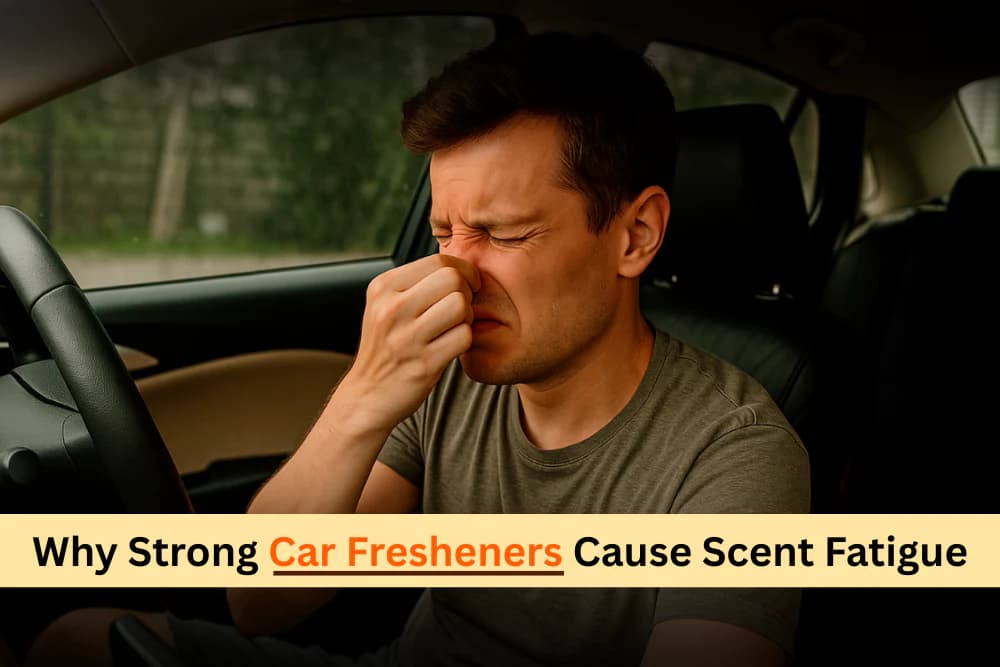
At first, a strong car freshener feels like the right choice. You open the door and the scent hits instantly, bold, powerful, unmistakable. For a short while, your car smells “properly fresh.”
Then something changes.
After a few days, the smell seems to disappear. You might even find yourself wondering if the freshener has already run out. On longer drives, you may notice a dull headache or a sense of irritation, without realising the fragrance could be the cause.
This experience is more common than most drivers realise. It’s not that the scent has vanished, it’s that your senses have adapted. This process is known as scent fatigue from car fresheners, and strong fragrances are the fastest way to trigger it.
What Is Scent Fatigue?
Scent fatigue occurs when your sense of smell becomes less responsive to a fragrance after continuous exposure. It’s also known as olfactory adaptation, and it’s a completely natural process.
Your brain is designed to filter out constant background smells so it can focus on new or potentially important ones. That’s why you stop noticing your own perfume after a while, even though others still can.
In a car, this effect happens much faster. The space is small, airflow is limited, and the scent source is often active at all times. Without breaks or variation, your nose quickly tunes the smell out.
Why Strong Car Fresheners Trigger Scent Fatigue Faster
The Problem With High-Intensity Fragrances
Strong car fresheners rely on high fragrance concentration to create an immediate impact. While this can feel impressive at first, it overwhelms your scent receptors rather than engaging them gradually.
Instead of enjoying the fragrance over time, your senses are forced to adapt quickly, showing why premium car air fresheners are designed for a more balanced, long-lasting scent experience.
Enclosed Car Interiors Make It Worse
Cars are enclosed environments with limited airflow. Unlike a room where scents can disperse naturally, a vehicle traps fragrance in a small cabin.
This means:
-
Constant exposure with no “reset” time
-
No variation in scent strength
-
Faster sensory overload
What might feel acceptable in an open space becomes tiring in a car within days.
Synthetic Oils and One-Note Scents
Many strong car fresheners rely on low-quality synthetic fragrance oils. These scents are often:
-
Sharp on first impression
-
Built around a single dominant note
-
Lacking balance or depth

As a result, they burn out quickly and feel harsh over time.
The Real-World Signs Drivers Experience
Scent fatigue doesn’t always announce itself clearly. Most drivers notice it indirectly.
Common signs include:
-
“I can’t smell my car freshener anymore”
-
Mild headaches during longer journeys
-
Feeling slightly nauseous or irritated
-
Passengers commenting on a strong smell while the driver notices nothing
This disconnect happens because the driver’s nose has already adapted, while new passengers haven’t.
Why Stronger Doesn’t Mean Longer-Lasting
A common misconception is that stronger scents last longer. In reality, the opposite is often true.
High-intensity fragrances:
-
Overstimulate the senses
-
Trigger faster adaptation
-
Feel inconsistent over time
Subtle, well-balanced scents may seem gentler at first, but they remain noticeable for longer because they don’t overwhelm the nose.
This is why many drivers feel their car freshener has stopped working, when in reality it comes down to why car air fresheners fade as the senses gradually adapt to a constant fragrance.
What a Balanced Car Scent Should Feel Like
Controlled Diffusion Over Instant Impact
A good car scent doesn’t shout the moment you open the door. Instead, it releases gradually, allowing your senses to engage naturally.

Controlled diffusion creates consistency rather than shock.
Layered Scent Profiles
High-quality car fragrances use layered notes, not a single overpowering smell. This depth keeps the scent interesting and prevents fatigue.
Rather than fading abruptly, the fragrance evolves subtly over time.
Designed for Long Drives, Not First Impressions
A balanced scent is designed to support your driving experience, not dominate it. It should feel comfortable on daily commutes and remain pleasant even on longer journeys.
How to Avoid Scent Fatigue in Your Car
To reduce the risk of scent fatigue:
-
Avoid placing fresheners directly in strong airflow
-
Lower scent strength instead of replacing it too quickly
-
Allow periods where no fragrance is used
-
Choose quality and balance over intensity
Small adjustments make a noticeable difference.
Are Strong Car Fresheners Ever a Good Idea?
Strong scents can be useful in specific situations, such as short-term odour neutralisation after spills or heavy smells. However, they are rarely suitable for everyday use.
For daily driving, comfort and subtlety matter far more making everyday car fragrances a better choice for a consistently pleasant driving experience.
The Takeaway: Comfort Beats Intensity Every Time
Scent fatigue isn’t a flaw in your sense of smell, it’s your body doing its job.
Strong car fresheners may feel effective at first, but they often lead to discomfort, faster fade, and a less enjoyable driving experience. A refined, balanced scent enhances your time behind the wheel rather than distracting from it.
When it comes to car fragrance, subtlety isn’t weakness, it’s quality.